Companionship is one of the things that I have had to deal with in my life. Being the middle child does not make it easier. I am used to being ignored and to just go with the flow when it comes to life and doing things that others want to do. One thing that really stood out to me in Petrarch’s work is that he needed the perfect companion to accompany him on his journey up the mountain. I think that I have found the similar plight while I have been in Italy. The hardest thing that I have experienced is the desire to be alone. Living in an apartment, it is difficult to find a place without another person in the room. And living in Italy, where there is no air conditioning, there is difficulty finding a room that is quiet because of the noises coming in through the window. Now that I am more familiar with the territory I would feel some comfort in going out alone, but that is not something that we have been advised to do. Also I don’t really want to go wandering around in a foreign country alone. So picking a companion is something I am very familiar with. If I want to go somewhere and think I would pick a person different than the one I would pick to go shopping. I think the fact that Petrarch picked his brother; who became a monk, is not a coincident. His brother was able to find the correct path up the mountain without getting side tracked while searching for an easier route. If this piece was written in 1352 like some scholars suggest than this piece could show Petrarch’s belief that becoming a monk was the most successful and pure path up the mountain of enlightenment. The fact that Petrarch kept searching for another path and got lost and discouraged added to the effect of the allegory. What this means is that the pathway to heaven can be tricky. It is easy to get distracted while looking for your own way up. However, if you follow the path set in front of you than you can achieve success more rapidly. Once he reached the top he reproached himself for the journey up there and for his longings when he should be content with what he has. I think this is very applicable to this trip. I do not long to be home; in fact I want to stay in Italy forever. I am content here. I was a bit concerned before coming over that I would be terribly homesick, but that hasn’t happened yet. I think that this trip has been placed in my life at the time when I needed it most. The people I am studying with could not have been a more varied group, yet our dynamics work in ways that improve the educational experience. I am completely content with where I am in relationship to the universe. This is what Petrarch was going for. You need to be satisfied with what god has given you and not long for anything else. Use the place, people and surroundings to become a better person instead of searching for something more.
Monday, June 13, 2011

Sunday, June 12, 2011
David to the Fourth Power
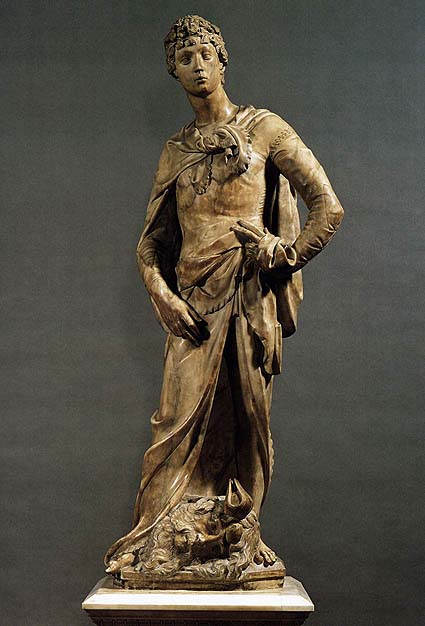 |
| Donatello's first David |
While in Florence the group had the opportunity to see the David; from the biblical story of David and Goliath, portrayed in four different ways by three different artists of the Renaissance. Donatello was the artist who completed two separate and varied sculptures of this biblical character. The first one that he was commissioned to do is strikingly different than the one he did later in his career. This David, which was commissioned to be put onto a Florence cathedral, was done in the early 1400s. It is fully clothed. The stance is contrapposto but it is lacking in emotion. The face of David seems unimpressed with the fact that there is the decapitated head of his foe at his feet. The overall effect of the statue is underwhelming because of the absent reaction in David’s eyes, stance, and appearance.
 |
| Donatello's later David |
Donatello’s more popular portrayal of David was commissioned in the mid-1400s. It is made completely out of bronze. The size is relatively smaller than the first sculpture because of its purpose. It was a private commission for the Medici family. It was a piece that was placed in their gardens, therefore the stature did not have to be as large as the first one that was meant for the façade of a cathedral. This David is younger and less developed than the previous one. He is also completely nude with the exception of the hat that he is wearing. The face has a suspicious smile that reminds me of the Mona Lisa. It exudes confidence in the stance, the face, and the self-assured way that he is standing on Goliath’s head and holding his sword for balance. This David is also in the contrapposto stance yet his long hair and hand on the hips give it a very effeminate quality. Our tour guide said this would have been the David that Michelangelo saw when he was beginning his artistic career. We also learned that the David became a symbol for Florence because he was a figure who, against all odds, was able to vanquish his foes. I find it hard to believe that this David was able to defeat Goliath but that is the point. It just stresses the point that no matter how weak or young you are that you have the capabilities to overcome the obstacles in your way.
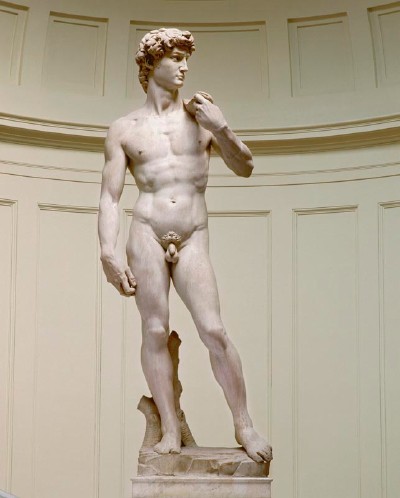 |
| Michelangelo's David |
Michelangelo’s David was completed in the early 1500s. It is the largest piece of sculpture that I have ever seen; 17 feet tall. There are sensors on the back of the left leg where the tree trunk is because it is beginning to crack under the weight of the rest of the sculpture. It only took him four years to complete. Seeing it in person was astonishing. You cannot tell in the photo how large it is. We talked about the sculpture in class before going to see it. We determined that the amount of emotion in the face and the range of interpretations that you can get from it was the most captivating part. Michelangelo took the idea of the Greek and Roman sculptures that emotion should only be seen in the eyes. There is thought behind the marble. While half of the class saw confidence the other half saw a combination of regret and worry. His stance is also in contrapposto but the muscles are more detailed than the previous Davids. Michelangelo looked to the Greek ideal of the perfect form when he was sculpting this piece. He was able to make it nude because of this rebirth but also because of Donatello’s statue. He saw this and was inspired. The fact that they aren’t wearing clothes could be symbolic of the fact that in the Bible David chose not to wear armor.
 |
| Bernini's David |
In Rome we saw Bernini’s David. It was a life-size figure and it is my personal favorite. The details that Bernini is known for does not disappoint in this piece. It was completed in the 1620s. The figure is in mid throw and Bernini has managed to capture the moment right before the release of the stone. David’s face is riveted in concentration and anticipation. His figure is strong but it is not as defined as Michelangelo’s sculpture. I think that he looks a little older and more defined than the biblical David. I think that the movement is more based in the Hellenistic movement than in the rebirth of the classical. This is probably because this piece was done after the Renaissance had reached its end. It is the only David that is not in the contrapposto form. Instead he is bent in preparation for the release of his rocks. The armor lays discarded at his feet. He is covered by a cloth that is loosely wrapped around his side and legs. I am guessing this is done because of the desire for censorship after the renaissance but I am not sure. The way these different Davids are shown is a way to see the evolution of art over the course of 200 years.
Thursday, June 9, 2011
Assessing Assisi
First off I want to talk about how top notch our tour guide, Marco was. He was invested in interacting with us as students and he was interested in having our particular fields of study connect with his tour. It was wonderful. He did an outline of the time period of the separate work for us by classifying each floor as a particular age in life. For example the work in the lower chapel was a baby because it was crawling away from the Byzantine period. There was still evidence of the influence previous to the renaissance in the art work. The details were not there, like in the bed of the pope or in the extremities of the body (toes and feet). There is no movement in the work either. The animals painted with St. Francis look like they are stationary and incapable of taking flight (Marco called them chickens). It is a step away from the Byzantine restrictions on art because the subject matter of the frescoes expanded beyond Mary, Jesus and the saints. In the side chapels is the artwork of Cimabue and Giotto. Their art work is considered to be the teenagers breaking away from the Byzantine art according to Marco. In other classes I have learned to believe that Giotto is more of an adult artist in his technique rather than at the teen stage. The difference between Cimabue and Giotto, as I have talked about in a previous post, is all in the detail. However I think that Cimabue had something on Giotto in this Basilica. I find it to be so different than the one we saw at the Uffizi Gallery. I was a little incredulous when I saw it. The figures had so much depth to them! If I had to choose one of the artists to accredit to this work I would have been wrong. I like this piece more than I do Giotto’s “Ognissanti Madonna.” I feel like Cimabue’s is more “grown-up” so to speak than Giotto’s work. It is darker also which gives it a more somber feel. I think what makes me appreciate this piece more than the Giotto one, or Cimabue’s piece in the Uffizi for that matter, is the lack of gold paint. The gold is overkill. I understand that it was a popular element in renaissance works because it is showing the glory and wealth of the patron but it gives no room for depth. Having the background and the halos both painted with gold makes it hard to differentiate the perspective. I like the fact that this Cimabue has depth and perspective through Mary’s throne and the placement of the angels that are surrounding it. There are no “grape-heads” in this painting. I also appreciate that it is balanced without being symmetrical. Saint Francis on the side is not symmetrical with the other figures; it appears as if he was stuck in there last minute. However, it does not seem like the side with Mary and the angels is more crowded. The wings of the angels seem dainty and almost opaque as well. They are quite realistic. Baby Jesus looks more like a real baby in comparison to Giotto’s baby Jesus. Usually in this period when Jesus is portrayed as a child he is given the face of an old man. This shows the wisdom of him. However, Cimabue’s baby, while still looking older than a child, has a more baby like quality to his face than Giotto’s does. One thing I do not like about this piece is the iridescent quality of Mary’s halo, while the other saints do not have that opaqueness. You can see the lines of the boarder in her halo while you cannot see the outlines of things behind the other halos. That is similar to the gold halos that Giotto painted. You could see nothing behind them. The placement and setup of Giotto’s throne is more realistic. Cimabue’s looks like it is rickety and that it might fall apart. It does not look real. The thing that really interested me about Cimabue was his desire to paint something accurate. He took the stories of St. Francis and compiled them to make the figure standing on the right of this painting. I think that is something to give him merit in the renaissance. He wanted everything to be correct. There was no falsity in his portrayal. I appreciate that about this piece.
 |
| Cimabue's Madonna |
 |
| Giotto's Madonna |
Tuesday, June 7, 2011
Circumnavigating Dante's Hell Circles
While reading Dante’s Inferno I am constantly looking at the people who Dante describes in the separate sections of hell and working out if they truly belong there or not. As I mentioned in class, I am a bit befuddled by the organization and deciding factors as to which circle a person ends up in. After previously reading this text I held the understanding that a person’s worst sin would be the corresponding circle that they would be forced to spend all of eternity in. However, for the first time I realized that this is not necessarily true. I thought about Aeneas and Dido and how their story is not fitting with the location that they ended up in. I believe that Aeneas should not have been located in Limbo. In his story he was led by the will of the Greek gods to fall in love with Dido so that he couldn’t continue on his journey to carry on the Trojan legacy. I think that it is a sign of weakness, not greatness. However he ended up in the first circle of hell at the crest of the Dolorous Abyss. He was surrounded by such people as Plato, Aristotle, and Hector. There really was no punishment except for the knowledge that they will never have the hope of reaching heaven. This circle is reserved for those who were born before Jesus and therefore did not believe in him. They had the misfortune of being before He washed away all of the sins. I don’t think that was Aeneas’s only sin though. I think that he was also an adulterer and a betrayer. So why is he in the ranks of such men like the ones mentioned above? And why does Dido get a lesser punishment than she deserves? She is in the 2nd circle of hell where those who gave into their appetite instead of reason; the lustful, are doomed. I understand that she did give into her lust when she and Aeneas were trapped in the storm. However, she also committed suicide which is in Circle 7. So why is she not there? If your place in hell is determined by the severity of your sin than why are these two people not in the rightful location? Or a better question is what right do I have to decide where these people end up in hell? Furthermore, what right does Dante have? This sins he is punishing people for are not equal. I think that if hell was set up the way he describes it; in circles based on the type of sin, than there would be some sort of system so that those people who were the worst would get the most fitting punishment. Another problem I have with this is that Ugolino is still damned to be a cannibal for the rest of his after-life. I can’t imagine that being a punishment that is equal to the man whose head he is continually gnawing on. To have to eat someone for the rest of your existence or to be eaten, that is the question. I understand that Dante is creating an underworld that is meant to strike fear in the sinner’s heart and to make them realize the consequences. That is why it is so graphic. However I think that he loses some of his reverence and authority in the subject because he is not always fair with the punishments.
Monday, June 6, 2011
Influence of Technique
I am constantly amazed at how art circles around and how the influence changes throughout history. I think what is the most shocking for me is how much a student and a teacher can differ. I know that everyone develops their own style but I find it hard to believe that technique can change that much over a short period of time. For example Picasso started out being classically trained by his father but over the course of his life became more and more abstract. I realized this in the Uffizi museum. We were looking at one of Giotto’s altarpieces in the center of the room while on the left and right there were similar pieces by Giotto’s teacher, Ciambue, and the teacher of Giotto’s teacher, Duccio da Buoninsegna. The difference was outstanding. The earliest piece was very flat and reminiscent of the Byzantine time period. The saints were stacked on top of each other without any sense of depth. I think there were three or four saints on each side of the Madonna and child. The next piece had the same subject and nearly similar composition. The only think that was a bit different is the drapery was a bit more lifelike. The Giotto piece was recognizably more modern. The forms had shadow and detail. Instead of the saints that flock around Mary looking like “grape-heads” (a term for when the heads look like a bunch of grapes piled on top of each other rather than individual forms) they actually looked like they are going back into the painting. They had individual characteristics. Despite the fact that they all use gold as the background and the halo/discs on the saints and Mary, Giotto’s was the one that had form and that you could make a differentiation between the purposes of the gold. The details in the fabric were also substantially better. It looked realistic and more natural than the folds in the fabric of the two previous works. Giotto was truly the father of perspective but I also think he had an impact on three-dimensionality. His figures were not flat. They had depth and something more than just paint on a surface. It was more realistic than what had previously been done before. This would allow the influence of artists to carry on and people like Michelangelo would have seen this and used it for their own work.
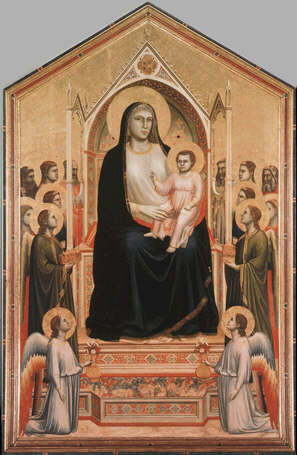 |
| Buoninsegna's "Rucellai Madonna" |
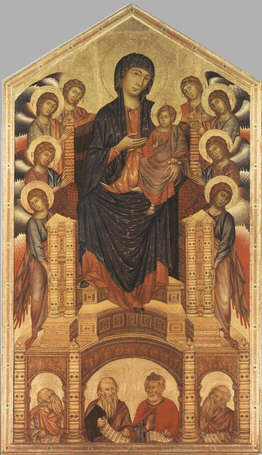 |
| Cimabue's "Santa Trinita Madonna" |
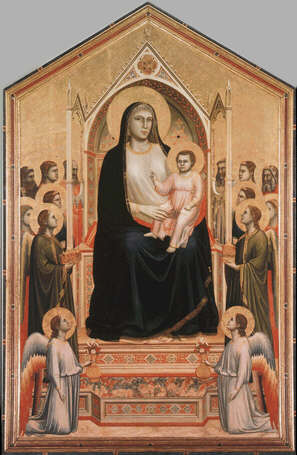 |
| Giotto's "Ognissanti Madonna" |
The Trevi Fountain and how it fits into the Renaissance ideal of perfect art:
BALANCE: The window that is painted on. I do not know exactly when that was painted on there but I am going to use it anyways. Despite the fact that it was not there originally, the window was added for the uniformity of the complete fountain. That and the proportion and order of the different sculptures of the god-like figures make the fountain very balanced.
ORDER: There is symmetry in the order of the fountain’s statues. The arrangement of the sculptures could be considered in the balance category but I think that because there is also the component of the whole fountain that is not representative of a river god this belongs in the order category. There is a mixture of the natural rock sculpture, or rocks that appear to be natural and that of the sculpted figures. They are ordered in an aesthetically pleasing manner so that the viewer is under the impression that the figures are mixed in with nature. I think it also gives the statue a bit of a naturalistic allusion. The juxtaposition of the hard stone and the water works in the way that it has the flow of the water against the jagged edges of the stone. It looks like it could actually appear in nature instead of at the hands of the designer.
PROPORTION: It is proportional because of its equal amounts of sculpture on each side. There is the largest and most eye-catching figure in the center of the fountain. He is placed at the back of the fountain in a domed area that is flanked by two other statues of women. Below them in the actual fountain part are two statues on either side of the largest man. On each side there is a horse and a god-like figure controlling the horse. Then the stones cascade like a waterfall into the fountain. Neither of these figures are equal but because of the subject matter and the general location it appears to be proportional. If you folded the fountain in half it would not be symmetrical but it also wouldn’t have any outliers.
PRECISION: The precision is in the detail. The muscles of the gods are well defined and it is very idealized. There was also the consideration of how the piece would look with water filling it up and the precise way that the water should fall once the sculpture was hooked up to an aqueduct. There is a lot of consideration to go into a fountain of that size. The designer also had to consider the building behind the fountain and what would be the best way to incorporate the two. I think that the juxtaposition of smooth marble and jagged cut marble is also a precision issue. Without that detail it could get very confusing and loose its naturalistic feel.
CONTROL: I may be stretching this point but I think the control in this piece is the ability for it to be so massive yet it is contained. The water does not spray outside of the intended location. It is contained while being expressive at the same time. The bucking horses and the jagged stone give the fountain the appearance of being like water, free flowing and gushing while in reality it is not. It is
CLARITY OF COMMUNICATION & MEANING: I don’t think that it is excessively difficult to find the meaning of this piece. I don’t know who the gods are in this, or if they are even gods to begin with. But what I receive from this piece is power. It is not a sculpture of a weakling. Whoever is in the center of that fountain is in control. He has the ability to master the flowing waters. Even the smaller people have the control over the horses that are near them. Even though this piece is over 500 years old it still has that awing affect.

Thursday, June 2, 2011
Musings on Plato
Something that I have been thinking a lot about is how to reach this level of purity at the top of the world of forms. I don’t know how much of the process that I subscribe to. As a Christian I know that the only way to Heaven is through Jesus Christ and having faith. I think that there are different paths for everyone in their walk with god. I do not see Plato’s argument that good is reached by thinking the correct ideal; the only ideal. Unlike Plato, I do not believe that there is a group ideal. There may be individual ideal. Each person is entitled to their own wants and desires and it varies based on the different personalities. The factors that attribute to the need for separate forms of perfection can be based on the separate cultural views, gender views, political views or any number of things. For example the ideal love for me would not be the same as my sister’s opinion. And my parents’ ideal child would not be the same as the ideal child from another country like China. My ideal education is the one I am receiving now but someone else might want a larger classroom or a more interdisciplinary education. Black Mountain College was formed because the professors wanted to provide a school for art students that didn’t fit into the mold of a rigid four year degree. For something to be so perfect that everyone is content would be somewhat impossible. There is the argument that God is the ideal but there are so many religions out there who do not subscribe to the same beliefs that I do that I don’t think He could be considered a GROUP ideal. One of our taxi drivers in Rome helped me realize this. He was of a Muslim faith and he correctly guessed that we were Christian. Then he said “But there is one God that fits for everyone.” We may not have the same god that our driver had, but that really doesn’t matter. His ideal god is Allah while mine is the Baptist version of God. Just because my God is different than his does not mean that we are not going in the same direction towards the Realm of the Good. I don’t see how people could be so varied through beliefs, race, gender, etc. though there exists only ONE entrance into the heavenly realm.
Subscribe to:
Posts (Atom)